
Hydrogen vs. Solar vs. Battery Storage: What's the Difference?
Hydrogen, solar, and battery storage get grouped together as alternative power, but they solve different problems. Here's how they actually compare on duration, availability, and footprint.
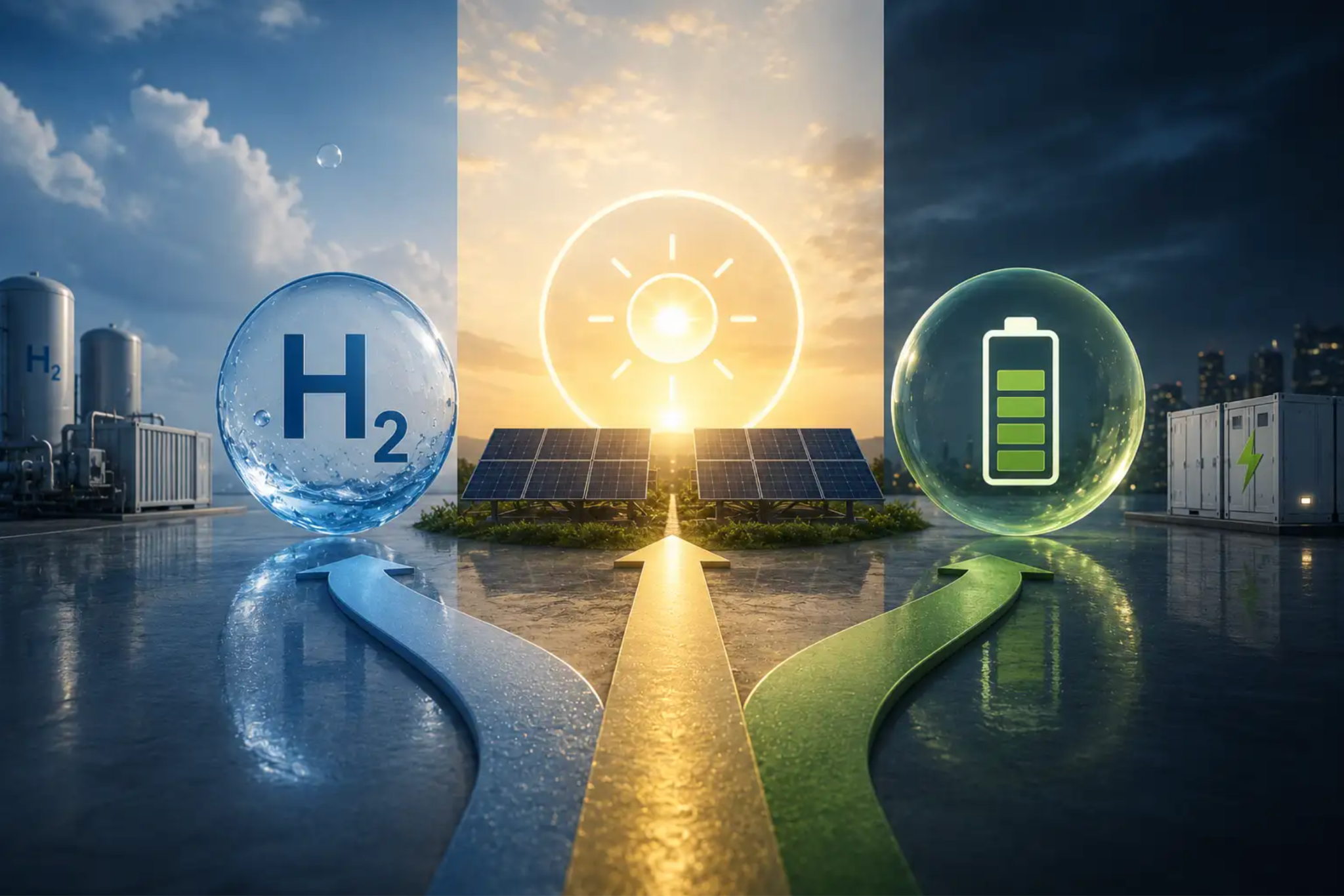
Hydrogen, solar, and battery storage get lumped into the same conversation often enough that it's easy to assume they're competing for the same job. They aren't. Each one is built around a different constraint, and the differences matter a lot once the question moves from "what generates power" to "what keeps the power on when it counts."
Here's how they actually compare.
Duration: How Long Can It Actually Run
The biggest practical difference between these technologies is how long the system can sustain output once demand outlasts supply rather than how the electricity gets made.
Battery storage is built for short-duration cycling. More than 90% of U.S. grid-scale battery capacity installed through 2022 has a duration of four hours or less, according to the National Renewable Energy Laboratory, and lithium-ion batteries have supplied about 99% of new storage capacity in recent years. That's not a limitation of the technology so much as its design purpose: batteries excel at smoothing short-term gaps, not carrying a site through a multi-day outage.
Hydrogen occupies a different category entirely. NREL's own technology comparisons classify chemical energy storage — hydrogen — as suited to seasonal-scale storage measured in multi-day periods, not hours, with the tradeoff being higher storage cost per unit rather than a duration ceiling. That's the gap a hydrogen platform like HOG™ is built to fill: not a faster battery, but a different category of power source suited to sustained, multi-day operation independent of the grid.
Availability: What Happens When the Sun Isn't Out
Solar's constraint isn't duration; it's availability. U.S. utility-scale solar operated at an average capacity factor of 24.4% in 2025, according to the U.S. Energy Information Administration's Electric Power Monthly (Table 6.07.B), compared to 91.0% for nuclear power and 58.4% for natural gas combined-cycle plants (Table 6.07.A). In practice, that means a solar installation generates at a fraction of its rated capacity on average, concentrated in daylight hours — and drops further in the darker winter months, when 2025 monthly capacity factors fell as low as 13.7% in December compared to 32.4% in July, according to EIA data. Cloud cover from a storm system compounds that same intermittency at the exact moment reliable power matters most.
A hydrogen platform doesn't have a daylight or weather dependency built into its fuel source. Water goes in regardless of cloud cover, time of day, or season, which is a structurally different reliability profile than a resource tied to sunlight.
Footprint: What It Takes to Site
Utility-scale solar requires 5 to 7 acres per megawatt of generating capacity, according to Solar Energy Industries Association estimates, before accounting for access roads, setbacks, and equipment space. That's a real constraint for sites where space, permitting timelines, or land cost rule out a solar buildout entirely: an industrial site, a data center campus, or a disaster zone with no available acreage to clear and grade.
A containerized platform like the Flying Pig™ is built around the opposite constraint: 1MW of output inside a single deployable container, with additional capacity added by adding modules rather than acreage.
Where Each One Actually Fits
None of this makes solar or battery storage the wrong choice. They're the right tool for different jobs. Battery storage is well-suited to daily grid-smoothing and short-interruption ride-through. Solar is a strong fit where land is available, sunlight is reliable, and the load profile lines up with daylight generation. Hydrogen fits where the job is different: sustained, multi-day, behind-the-meter power that doesn't depend on weather, sunlight, or a fuel truck reaching a disaster-affected site.
The question isn't which technology is best in the abstract. It's which one is built for the actual conditions a given site has to survive.
Get In the Room
See the Arsenal for the full HOG™ and Flying Pig™ specification blocks, or reach out to talk through what fits a specific site.
