
How Hydrogen Is Made From Water: Electrolysis Explained
Electrolysis is the process that turns water into hydrogen fuel. Here's a plain-English explanation of how it works, what the U.S. Department of Energy says about it, and where VIVIFY's platform fits in.
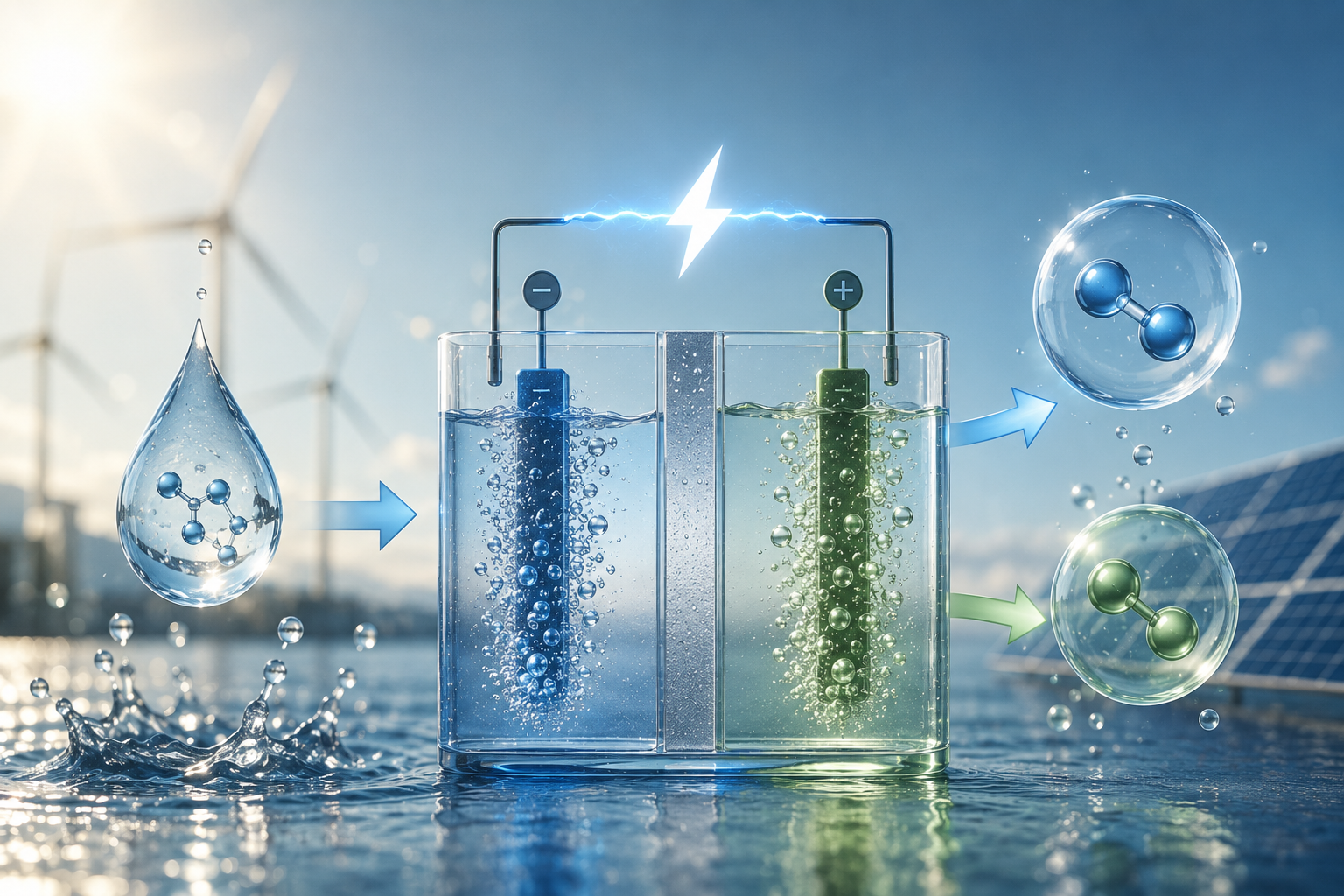
To be used at scale, hydrogen has to be separated from whatever it's bonded to, most commonly oxygen, in water. The process that does that separation is called electrolysis, and it is the engineering foundation of a water-fueled hydrogen platform.
Here is what electrolysis actually is, how it works, and why it matters that it's become a commercially deployable process rather than a laboratory demonstration.
Electrolysis, in One Sentence
According to the U.S. Department of Energy, electrolysis is the process of using electricity to split water into hydrogen and oxygen, and it takes place inside a unit called an electrolyzer. That's the entire concept. An electric current runs through water, the water molecule breaks apart, and hydrogen and oxygen come out the other side as separate, usable elements.
The U.S. Energy Information Administration describes it plainly as well: “Electrolysis is a clean process, producing only hydrogen and oxygen, with no other byproducts or emissions.”
Electrolysis Isn't the Only Way to Make Hydrogen, But It's the One That Matters Here
Most of the hydrogen produced in the United States today is not made this way. The Department of Energy estimates that roughly 95% of commercial hydrogen currently comes from steam-methane reforming, a thermal process that extracts hydrogen from natural gas rather than water. That method has historically been cheaper at industrial scale, which is why it dominates current production.
Electrolysis is the pathway that doesn't require a hydrocarbon feedstock at all. It needs only water and electricity. That distinction is the entire reason a water-fueled hydrogen platform is possible in the first place.
What Happens Inside an Electrolyzer
An electrolyzer functions with two electrodes separated by an electrolyte; conceptually, a fuel cell running in reverse. Instead of combining hydrogen and oxygen to produce electricity the way a fuel cell does, an electrolyzer uses electricity to pull hydrogen and oxygen apart from water.
Inside VIVIFY's HOG™ platform, that role belongs to Pulsar™, a proprietary component that generates hydrogen on demand at the rate the system is consuming it, rather than producing and storing large volumes of hydrogen gas on site. The hydrogen produced then moves through HOG™'s multi-stage turbines and combustion chambers, where it becomes usable power and heat, a 99% emission-free result because the input was water rather than a fossil fuel.
The Economics Are Moving in Hydrogen's Favor
Electrolysis has historically been more expensive than steam-methane reforming, but that gap has been closing. The Energy Information Administration has also tracked a sharp rise in planned U.S. electrolyzer capacity — from 116 megawatts currently installed to more than 4,500 megawatts in announced projects — a signal that the economics are shifting enough to justify real capital investment.
The technology and the economics have both moved substantially in the years since hydrogen was treated as a distant possibility. What used to be a cost problem is increasingly becoming an engineering and deployment problem, which is the problem VIVIFY built HOG™ to solve.
Get In the Room
See the Arsenal for the full HOG™ specification block, or reach out to talk through how a water-fueled hydrogen platform fits a specific site.
