Grid Resilience 101: What Florida's Utilities Can't Do Alone
Adding grid capacity now takes years, not because utilities are slow but because of a national interconnection process and equipment supply chain that no single utility controls. Here's how that actually works.
It's easy to treat slow grid capacity growth as a utility problem. It mostly isn't. Adding new generation or transmission capacity to the grid today runs through a national interconnection process and an equipment supply chain that no single utility controls, so even a well-run, well-capitalized utility often waits on systems outside its own walls.
Here's how that process actually works, and where it structurally can't move faster no matter how well any individual utility is operating.
The Interconnection Queue: Years, Not Months
Before a new power source — a solar farm, a battery installation, a gas plant — can connect to the transmission grid, it has to complete a formal interconnection study process run by the regional transmission operator, not the local utility alone. As of the end of 2024, roughly 2,290 gigawatts of generation and storage capacity were sitting in these queues nationwide, according to Lawrence Berkeley National Laboratory's "Queued Up" report, nearly twice the capacity of the entire existing U.S. power plant fleet.
And over time, the wait itself has gotten longer, not shorter. The median time from an interconnection request to commercial operation has more than doubled, from under two years for projects built between 2000 and 2007 to over five years for projects reaching completion in 2025, per the same LBNL analysis. That's not a reflection of any one utility's pace; it's the queue itself, a shared, multi-project study process that every new connection has to move through in sequence.
The Equipment Problem: A Global Supply Chain, Not a Local One
Even once a project clears the interconnection process, building it requires large power transformers, and those are now a global bottleneck. Lead times for large power transformers have stretched to between 80 and 210 weeks (up to four years), according to a 2024 report from the federal National Infrastructure Advisory Council, up from historical norms closer to a few months. The North American Electric Reliability Corporation has separately reported standard transformer lead times crossing 120 weeks in 2024 and continuing to climb into 2025.
Distribution transformers — the smaller equipment that brings power the rest of the way to homes and businesses — saw similar pressure, with average lead times rising from 8 to 12 weeks in 2020 to as long as three years by 2022, according to a bipartisan U.S. Senate letter addressed to federal energy officials. A limited number of domestic manufacturers, combined with global demand for the same core materials — grain-oriented electrical steel and copper — sets the pace here, not utility decision-making.
Why This Isn't a Utility Failure
None of this reflects poorly on the utilities managing the grid day to day. A regional interconnection queue and a global transformer supply chain are structural systems that operate above the level of any individual utility's control — the same constraint applies whether the utility is large or small, well-funded or not. Florida's utilities are working within a national process and a global equipment market, not a local one, when it comes to adding new grid-connected capacity.
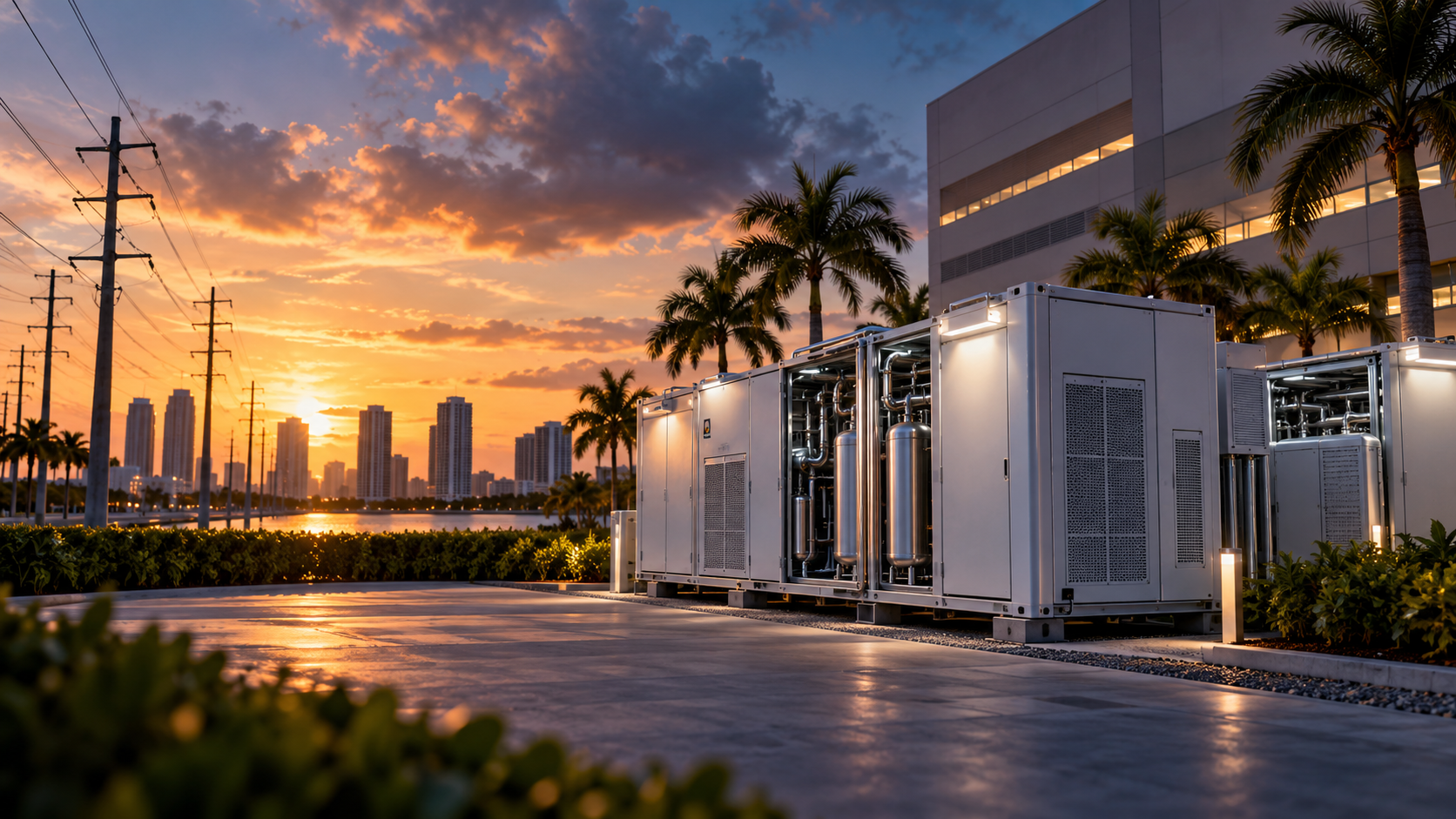
That's exactly the gap VIVIFY's platforms are built to work alongside, not against. A behind-the-meter hydrogen system doesn't wait in the same interconnection queue or compete for the same transformer backlog, because it isn't adding new generation to the transmission grid at all. It's dedicated capacity, built on-site, for the customer that needs it, running in parallel with the timeline the grid is already on.
What This Means for a Site That Can't Wait Five Years
A data center, hospital, or industrial site with a power need today doesn't have five years to wait for an interconnection queue to clear or four years for a transformer to arrive. HOG™ is engineered as a self-supporting, behind-the-meter power platform that can be sited and scaled without needing a place in that queue. It's not a substitute for the grid utilities operate; it's a way for a specific site to get dedicated power on the timeline it actually needs, while the broader grid capacity conversation plays out on its own, much longer timeline.
Schedule a Capability Review
See the Arsenal for VIVIFY's full platform lineup, or schedule a capability review with the VIVIFY team to talk through what behind-the-meter power looks like for a specific site.
Follow VIVIFY on LinkedIn and Instagram for deployment updates and behind-the-scenes footage from the field.
