
Emergency Power for Hospitals: What Critical Facilities Need Before the Storm Hits
Hospitals are legally required to have backup power. Hurricane Sandy showed that compliant systems can still fail. Here's what the law requires, what's gone wrong before, and what critical facilities need before the next storm.
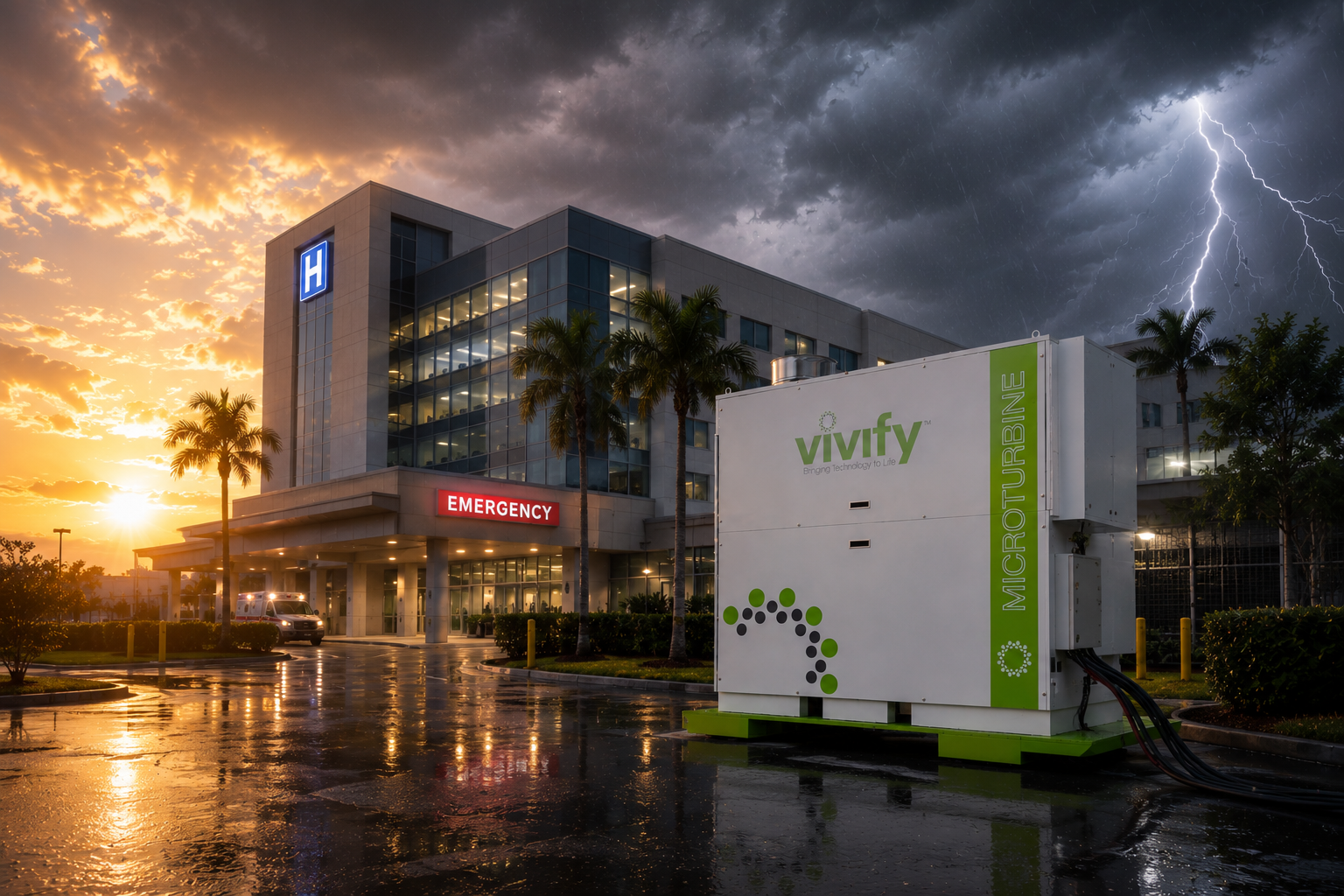
A hospital that loses power isn't just dealing with an outage. It's dealing with a life-safety event. That's why backup power for hospitals is regulated more strictly than almost anywhere else.
Here's what the law actually requires, what's gone wrong even at compliant facilities, and what critical facilities need before the next storm arrives.
What the Law Requires
Under the Centers for Medicare & Medicaid Services' Emergency Preparedness rule, hospitals must maintain alternate energy sources capable of sustaining safe temperatures, emergency lighting, fire detection and alarm systems, and sewage and waste disposal, according to the regulation at 42 CFR 482.15.
Hospitals are also required to maintain enough fuel on site, or under a documented resupply agreement, to sustain emergency power operations for 96 hours — a standard strengthened directly in response to what happened during Hurricane Katrina, when hospitals lost backup power after days without resupply. CMS enforces the rule through its survey process, and hospitals typically meet it by installing generators built to industry standards for backup power system performance and reliability.
When the Backup Plan Became the Story
Regulatory compliance and real-world reliability aren't automatically the same thing. During Hurricane Sandy in 2012, New York University's Langone Medical Center had backup generators in place that met code — one in the basement, one on the roof. When floodwater reached the basement, it disabled one generator directly and cut off the fuel supply to the other. The hospital evacuated roughly 300 patients, including about 45 in critical care and 20 newborns carried down darkened stairwells, according to reporting at the time from ABC News and NPR.
A few miles away, Bellevue Hospital — in continuous operation since 1736 — ran on backup generators for a day after losing utility power, until floodwater reached 17 million gallons in the basement housing its fuel infrastructure. The hospital evacuated roughly 500 patients, according to CBS News. Both facilities were regulation-compliant. Neither backup system survived contact with the actual disaster it was built for.
The Failure Wasn't the Fuel. It Was Where the Fuel Lived.
Neither NYU Langone nor Bellevue actually ran out of diesel. Their systems failed because the equipment itself — generators, fuel pumps, electrical switching gear — sat in basements, which is where hospital backup infrastructure has traditionally been built-in. When floodwater reached those basements, it didn't matter that the tanks were full or that the 96-hour rule was satisfied on paper. The equipment was underwater.
That's a siting problem as much as a fuel problem, and it's specific to how legacy backup systems get installed: permanently built into the structure, in the same below-grade space as the rest of the building's electrical and mechanical infrastructure, because that's where it's always gone.
Why the Same Failure Doesn't Repeat
VIVIFY's platforms are built differently on both counts that mattered at NYU Langone and Bellevue:
Positioning isn’t fixed. The Flying Pig™ is a containerized unit, not a system built into a building's foundation. It can be positioned on elevated ground, a rooftop, an upper parking level, or wherever a site's flood risk is lowest because it doesn't require the same permanent integration a basement-installed generator does. A hospital isn't stuck putting it wherever the original electrical infrastructure happened to be designed.
Floodwater isn't a threat to the fuel supply. HOG™ and Flying Pig™ run on water as an input, including salt water, murky water, or contaminated water. A flood event doesn't cut off that fuel source the way it cuts off a diesel truck's route or ruins a compromised tank; if anything, the water a storm leaves behind is a usable input rather than a liability. That's a structurally different relationship to the disaster than a diesel system has, where floodwater and fuel delivery failure are both direct threats.
None of that eliminates the need to protect electrical equipment from water intrusion — any powered system still needs to be physically safeguarded from submersion. What changes is that VIVIFY's platforms aren't locked into the basement in the first place, and the fuel itself doesn't become a liability when the disaster is the kind that leaves water behind.
The Sandy-era hospitals did what the code required. What they needed was a system that wasn't installed in the exact location the disaster was guaranteed to reach, running on a fuel that didn't disappear the moment the roads did.
Request a Briefing
VIVIFY works with hospitals, health systems, and emergency management planners to build power architecture that holds up past code compliance. Request a briefing with the VIVIFY team.
Follow VIVIFY on LinkedIn and Instagram for deployment updates and behind-the-scenes footage from the field.
