Behind-the-Meter Power for Data Centers: Costs, Permits and Timelines
Compare behind-the-meter data center power costs, permitting requirements, and grid connection timelines using 2026 data.
For a new data center, the hard question is no longer whether you can get power. It is when. Behind-the-meter generation, meaning power produced on your side of the utility meter and used on site, has moved from a backup plan to a primary strategy for many developers thanks to long delays in traditional power hookup. Here is what the 2026 data says about the three things that decide whether it makes sense for your project: timeline, cost, and permits.
Timelines: The Grid Clock vs. the On-Site Clock
Start with the grid. In its April 2026 report, “Key Questions on Energy and AI,” the International Energy Agency (IEA) found that waiting times for grid connections can run five to ten years in many jurisdictions. Equipment adds its own delays: the same report puts average lead times for transformers at two to three years.
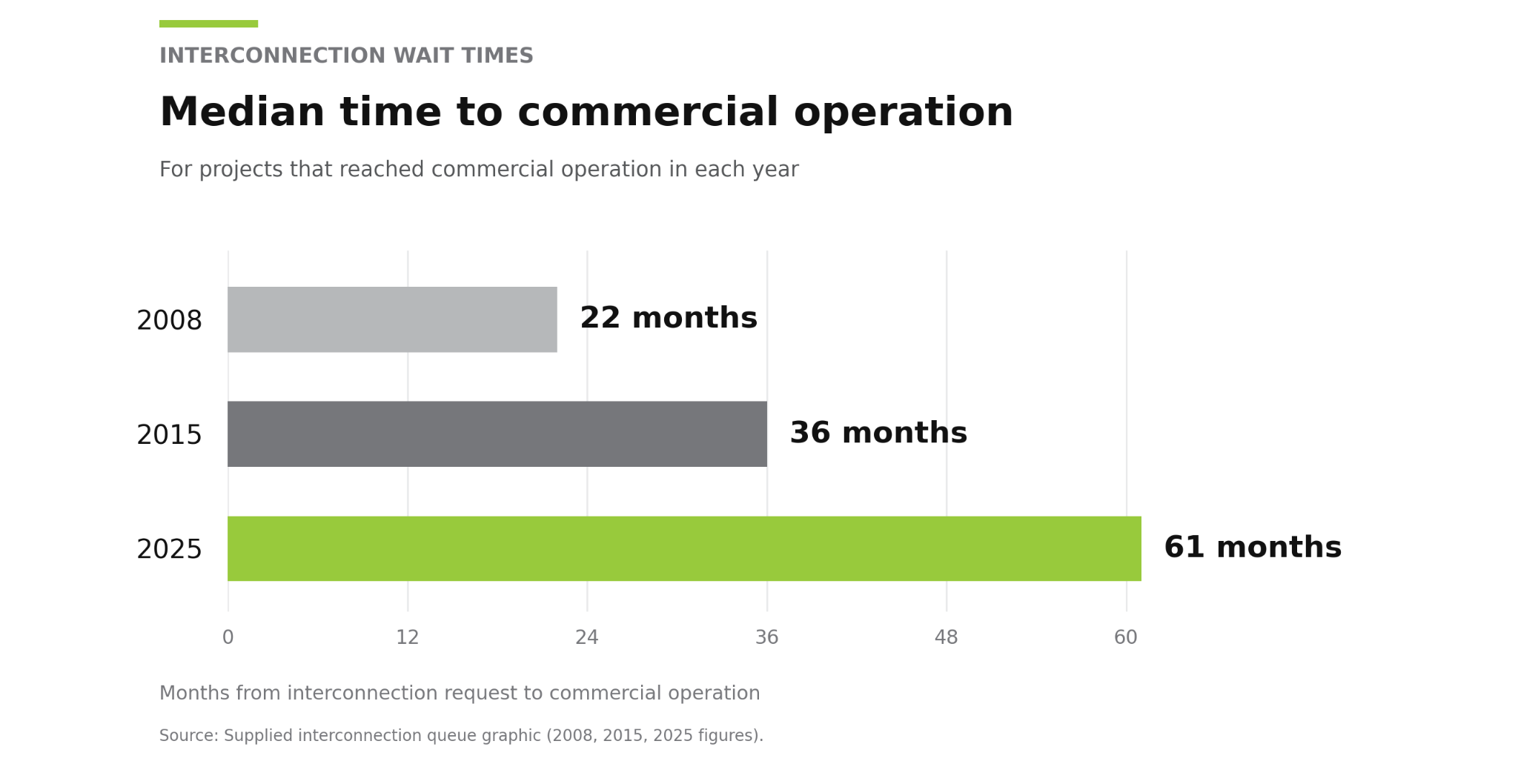
If your plan involves building generation that exports to the grid, the queue is just as slow. Lawrence Berkeley National Laboratory’s Queued Up: 2026 Edition found that the median project built in 2025 took 61 months from interconnection request to commercial operation, up from 36 months in 2015. Only 13% of the capacity that entered queues from 2000 to 2020 had come online by the end of 2025.
Behind-the-meter power takes you out of the grid queue, but it does not remove every delay. How fast you get power depends on the equipment you choose. The IEA reports that gas turbine deliveries could take around five years, following a 70% surge in turbine orders in 2025. It also cautions that on-site generation does not automatically promise a faster route to market for data centers at scale. Your timeline depends on how quickly the equipment itself can arrive and be installed.
Costs: What You Pay For, and What Waiting Costs
The U.S. Energy Information Administration’s Annual Energy Outlook 2026 assumptions give a federal baseline for new generation, in 2025 dollars per kilowatt of capacity:
- Industrial frame combustion turbine: about $1,158 per kW, with a two-year modeled lead time.
- Aeroderivative combustion turbine: about $2,275 per kW, with a two-year modeled lead time.
- Fuel cells: about $8,287 per kW, with a three-year modeled lead time.
- Battery storage: about $1,521 per kW, with a one-year modeled lead time.
Two cautions apply. These figures describe utility-scale plants, from 10 MW fuel cell installations up to 419 MW turbines, so smaller on-site units can cost more per kW. And a data center cannot run on exactly as much generation as it uses. The IEA found that reliable on-site gas power for critical, variable data center load requires overbuilding generation by 30% to 70% relative to demand.
Now compare that to what sits idle while you wait. The IEA estimates that cutting-edge AI data centers carry capital costs of $40,000 to $50,000 per kW, including IT equipment. Even with overbuild, on-site generation is a small share of that total. Every month a finished building waits for power is a month that investment earns nothing.
The grid path carries its own costs, too. In Florida, Chapter 2026-65 (SB 484) requires utility tariffs to ensure each customer with an anticipated peak load of 50 MW or more bears its own full cost of service, including connection, incremental transmission, incremental generation, and other infrastructure. The law also lets the Florida Public Service Commission approve take-or-pay provisions, which require payment for contracted capacity regardless of actual use, along with minimum contract terms and financial guarantees.
Permits: What Applies On Site
Behind-the-meter does not mean fully permit-free. It means having a different set of permits, several of which changed in 2026.
Air permits. Combustion-based generation typically needs Clean Air Act permitting. In May 2026, the U.S. Environmental Protection Agency proposed redefining “begin actual construction” so developers could start non-emitting work, such as certain cement pads, wiring, and support structures, before receiving a major New Source Review permit. EPA names data centers and power generation among the projects it would cover. As of this writing, the rule is still a proposal.
Grid-isolated plants. In July 2026, EPA issued guidance concluding that islanded power facilities, which are not connected to a public grid and do not sell electricity, are not subject to the Acid Rain Program. EPA notes that a facility connected to the grid later may become subject to it.
Florida siting. Florida’s Power Plant Siting Act, administered by the Florida Department of Environmental Protection, applies to steam or solar generating facilities of 75 MW or more. Federal permits still apply separately.
Florida water and land use. Chapter 2026-65 preserves local authority over planning and land development for large load customers and sets new conditions on water-use permits for large-scale data centers. Cooling and generation design choices that reduce water draw can simplify this step.
Federal grid rules. In June 2026, the Federal Energy Regulatory Commission ordered all six regional grid operators it oversees (PJM, MISO, SPP, CAISO, ISO-NE, and NYISO) to justify or reform their tariffs for data centers and other large loads. Accommodating co-location agreements and behind-the-meter generation is one of five reform areas FERC named. While Florida falls outside those six markets, the orders show where national rules are heading.
Putting It Together
Behind-the-meter power makes the most sense when three things are true: your grid connection date is years away, your load can be phased, and the generation you choose can arrive faster than the grid. Map all three before you commit capital, and get your permitting path documented early, since several 2026 rules are still in motion.
Where HOG™ and the Flying Pig™ Fit
VIVIFY engineered the HOG™ platform as a self-supporting, behind-the-meter hydrogen power system, with water as the input. Because generation and use sit on the same side of the meter, HOG™ adds dedicated capacity without a place in a transmission interconnection queue, and it scales from a single site to a full campus.
For phased builds, the Flying Pig™ delivers 1MW per containerized unit, with field assembly measured in hours, not weeks. Units couple together, so capacity grows as each data hall fills. Neither platform depends on a gas turbine delivery slot.
Bring VIVIFY to Your Site
Share your load ramp, utility timeline, and site constraints. The VIVIFY engineering team will show you what behind-the-meter capacity looks like for your project, phase by phase. Reach the team via our contact page or 888.277.8370.
Still gathering information? Follow VIVIFY on LinkedIn and Instagram for deployment updates and engineering news from the Delray Beach lab.
