
Behind-the-Meter Power, Explained: What It Means and Why It Matters
Behind-the-meter power means generation on the customer's side of the utility meter, rather than power that has to travel across the transmission grid. Here's what that actually means and why it's become a central issue in U.S. energy policy.
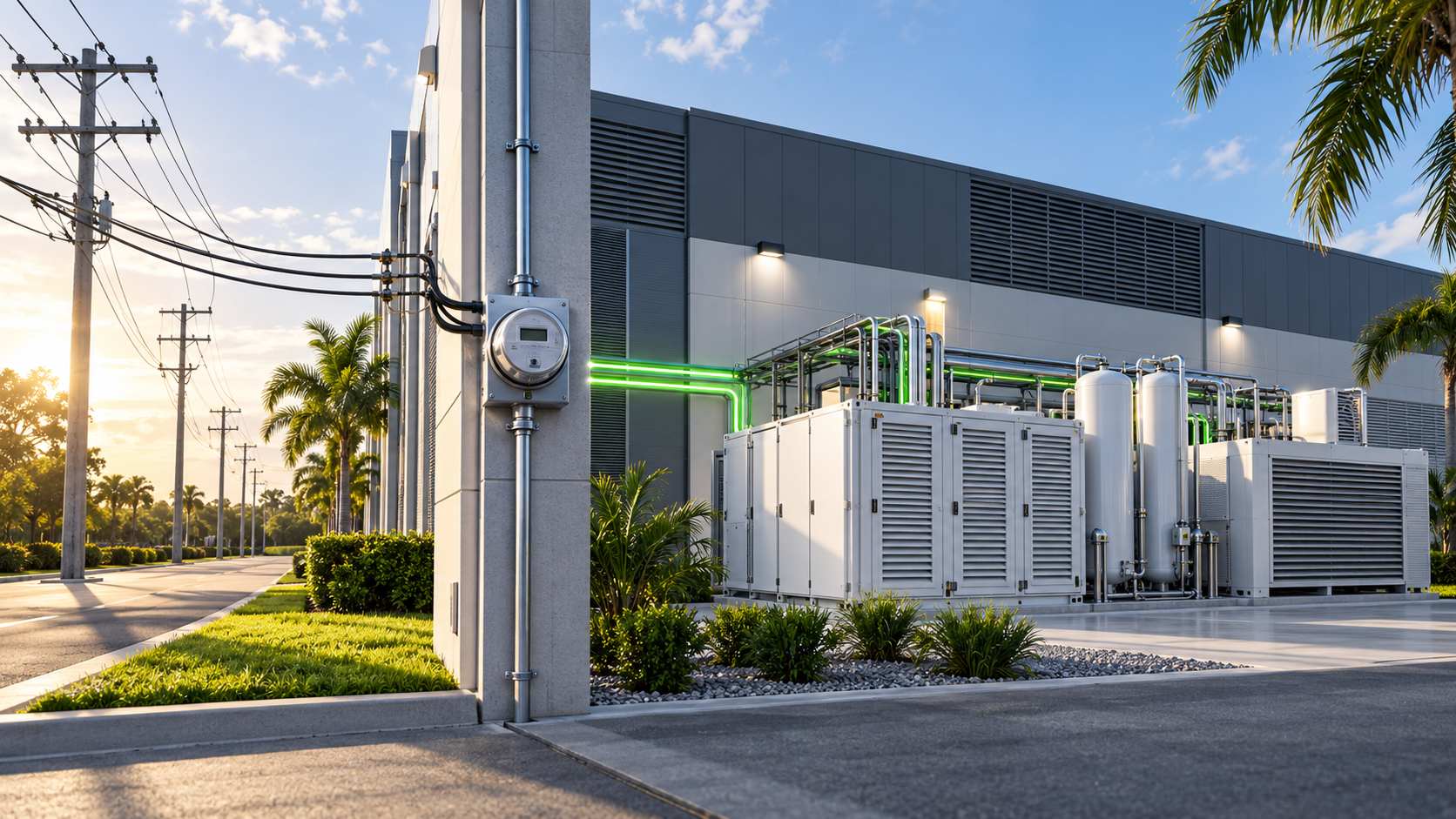
"Behind-the-meter" is one of those terms that gets used constantly in energy conversations without much explanation, on the assumption everyone already knows what it means. Here's the plain-English version, and why it's become one of the most actively contested terms in U.S. energy regulation right now.
The Meter Is the Dividing Line
Every electricity customer's service meter marks a boundary. On one side is the utility grid: the transmission and distribution system that carries power from power plants to the meter. On the other side, on the customer's side, is everything the meter measures: the building, its equipment, and anything generating or storing power there. "Behind the meter" refers to generation or storage located on that customer side, connected to the customer's own systems rather than feeding power across the grid first.
The alternative is "front-of-the-meter" power: the large, centralized power plants that connect directly to the transmission and distribution system and deliver power to customers through that grid, passing through the meter before it reaches the end user.
Why the Distinction Matters in Practice
Behind-the-meter power changes who owns it, where it's installed, and — critically — how it's regulated. According to a National Renewable Energy Laboratory technical report on behind-the-meter battery storage, BTM systems are connected to the distribution system on the customer's side of the meter, which is what allows them to serve the customer's own load directly rather than being dispatched through the broader wholesale power market the way front-of-the-meter generation typically is.
That distinction has become a live regulatory fight, not just a technical one. In December 2025, the Federal Energy Regulatory Commission directed PJM Interconnection — the nation's largest grid operator — to rewrite its behind-the-meter generation rules, according to FERC's own fact sheet on the order, specifically to address how data centers and other large loads can co-locate with on-site generation. The rules at the center of that fight were originally written in 2004, long before today's data center power demand existed at anything like its current scale.
Why Behind-the-Meter Power Is Having a Moment
Behind-the-meter power is gaining attention now for a specific reason: it's a way to get dedicated power to a site without waiting in line for new transmission-connected generation, which — as the current multi-year interconnection backlog shows — can take years. A behind-the-meter system doesn't need a place in that queue, because it isn't adding generation to the transmission grid in the first place. It's serving the load directly, on-site.
That's exactly why data center operators, industrial campuses, and hospitals have all started evaluating behind-the-meter options more seriously, not as a replacement for grid power but as a way to get dedicated capacity on a timeline the grid-connected alternative can't currently match.
Where VIVIFY's Platforms Fit
HOG™ is built as a self-supporting, behind-the-meter hydrogen power system: generation and consumption on the same side of the meter, engineered to scale from a single site to a full campus without requiring a place in a transmission interconnection queue. The containerized Flying Pig™ works the same way at a smaller, faster-to-deploy scale. Both are designed to answer the same question a growing list of large-load customers are asking: how do I get dedicated power now, on my own site, rather than waiting for the broader grid to catch up?
See the Arsenal
See the full HOG™ and Flying Pig™ specification blocks, or reach out to talk through what behind-the-meter power looks like for a specific site.
Follow VIVIFY on LinkedIn and Instagram for deployment updates and behind-the-scenes footage from the field.
