
AI Data Centers Are Straining the Grid. Here's Where Hydrogen Fits In.
U.S. electricity demand is hitting record highs on AI data center growth, and grid regulators are now issuing their highest-severity reliability alerts over it. Here's what's actually happening, and where behind-the-meter hydrogen fits.
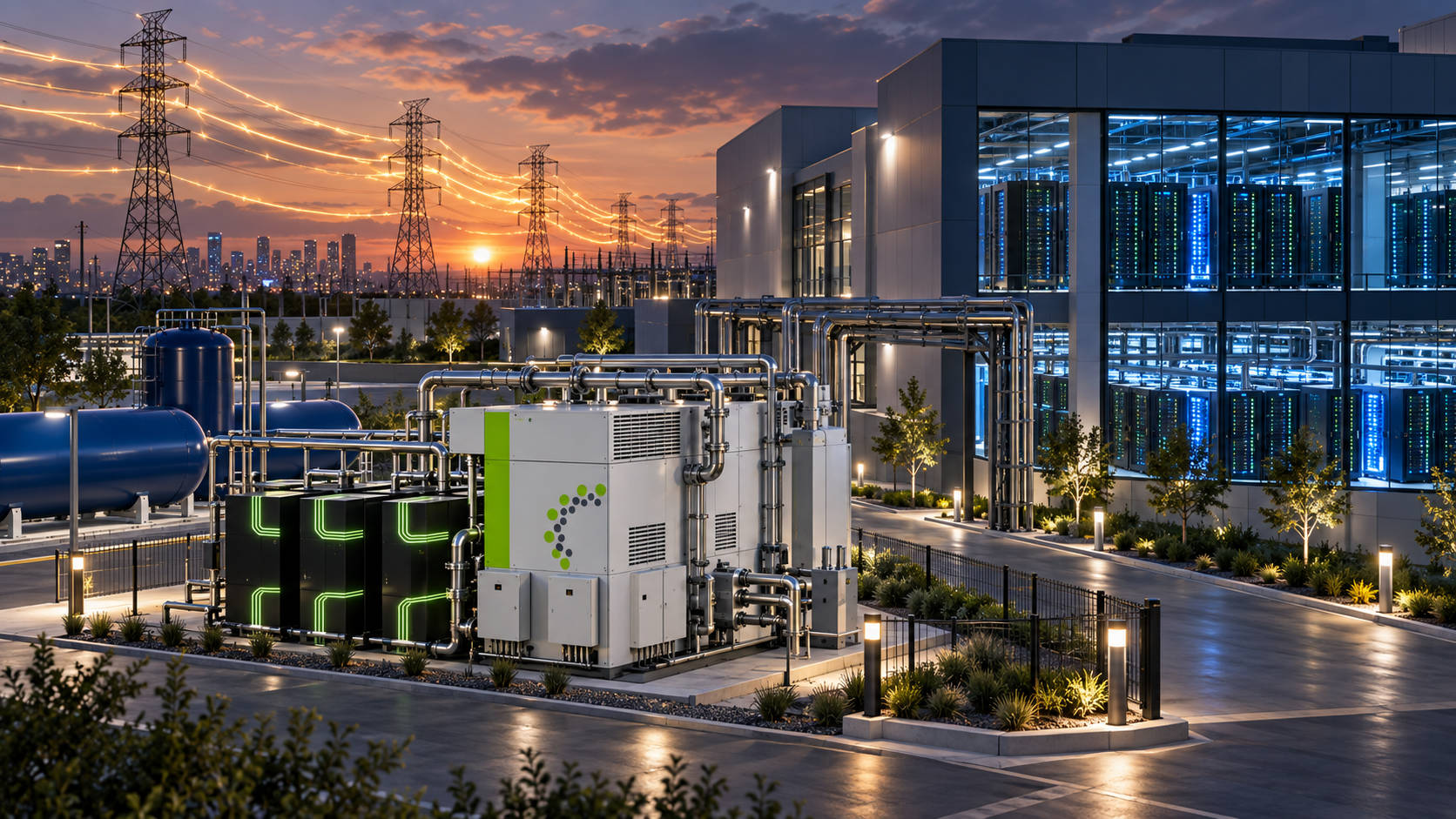
Two separate federal bodies are now on record about the same problem from two different angles. One tracks how much power the grid needs to deliver. The other tracks whether the grid can deliver it safely. Both are flagging AI data centers as the reason.
The Demand Number Itself
U.S. electricity sales are on track to hit 4,135 billion kilowatt-hours in 2026 and 4,211 billion kilowatt-hours in 2027, driven by data center development, according to the U.S. Energy Information Administration's September 2026 Short-Term Energy Outlook. The EIA's own outlook notes that this growth is happening despite a pause in connecting new data center projects to the grid in Texas, a detail the agency includes because Texas's West South Central region is still projected to account for the largest share of the nation's electricity sales growth, even with that pause in place.
That's worth sitting with: demand is setting records in the same outlook that acknowledges one of the country's largest grid operators has had to stop connecting new data center load.
This Isn't Just a Demand Problem. It's a Stability Problem.
The more urgent issue is how AI data centers behave on the grid when something goes wrong elsewhere, rather than how much power they need. According to the North American Electric Reliability Corporation's own Reliability Guideline on the issue, there are documented incidents of large loads, including data centers, unexpectedly reducing their demand from the grid during and after normally cleared faults: voltage-sensitive equipment tripping offline in response to a disturbance that the system was otherwise designed to absorb without incident. At certain scales, NERC notes, this kind of sudden load loss can risk cascading outages on a timescale of cycles to seconds — a single 60 Hz grid cycle is about 1/60th of a second, so the failure window can be faster than any operator could react to in real time — with the acceptable threshold depending on local grid strength and inertia.
NERC has treated this as serious enough to issue a Level 3 alert (the organization's highest severity level, and one it rarely uses), requiring registered utilities and grid operators to assess and report on how they're accounting for these large, voltage-sensitive computational loads in their planning and protection practices. Part of what makes this hard to plan around: large loads also tend to cluster geographically near favorable conditions like low-cost power and available substations, according to NERC, concentrating demand in specific locations that may not have the local transmission or generation capacity studies originally assumed.
Why the Usual Fix Takes Years
The standard way to add grid capacity is to connect new generation through a regional interconnection queue — and as of the end of 2025, that queue still carried roughly 2,061 gigawatts of generation and storage capacity nationwide, with a median wait now exceeding five years from interconnection request to commercial operation, according to Lawrence Berkeley National Laboratory's most recent interconnection queue data. A data center that needs gigawatt-scale power today isn't well served by a process built around a multi-year timeline, no matter how urgently the demand is growing.
Where Behind-the-Meter Hydrogen Fits
A behind-the-meter hydrogen platform sidesteps both halves of this problem, not by fixing the grid's queue or its stability challenge directly, but by not adding to either one. Power generated and consumed on the customer's own site never enters the interconnection queue, and it isn't pulling load from — or suddenly dropping off — the bulk power system NERC is now watching closely. It's a dedicated supply for one customer's load, engineered and sited for that specific site.
HOG™ is built as a self-supporting, behind-the-meter hydrogen power platform that scales from a single site to a full campus. For a data center operator facing both a multi-year interconnection wait and a regulatory environment newly focused on how large computational loads behave on the grid, dedicated on-site power isn't a workaround. It's a direct answer to the specific constraint each data center actually faces.
Schedule a Capability Review
See the Arsenal for VIVIFY's full platform lineup, or schedule a capability review with the VIVIFY team to talk through what behind-the-meter power looks like for a specific campus.
Follow VIVIFY on LinkedIn and Instagram for deployment updates and behind-the-scenes footage from the field.
