
8–14 named storms
Projected for the 2026 Atlantic season, with 3–6 forecast to become hurricanes. NOAA’s own guidance to residents: “it only takes one.”
Application 01 — Emergency Deployment
When disaster strikes, when the mission demands field power, when the grid is damaged, delayed, or simply absent, the agencies responsible for the response cannot wait for utility restoration.
Flying Pig™ is a containerized, behind-the-meter hydrogen power platform built for rapid deployment, zero ongoing fuel resupply, and scalable capacity that moves with the mission—from disaster recovery to forward operating environments to humanitarian infrastructure restoration.
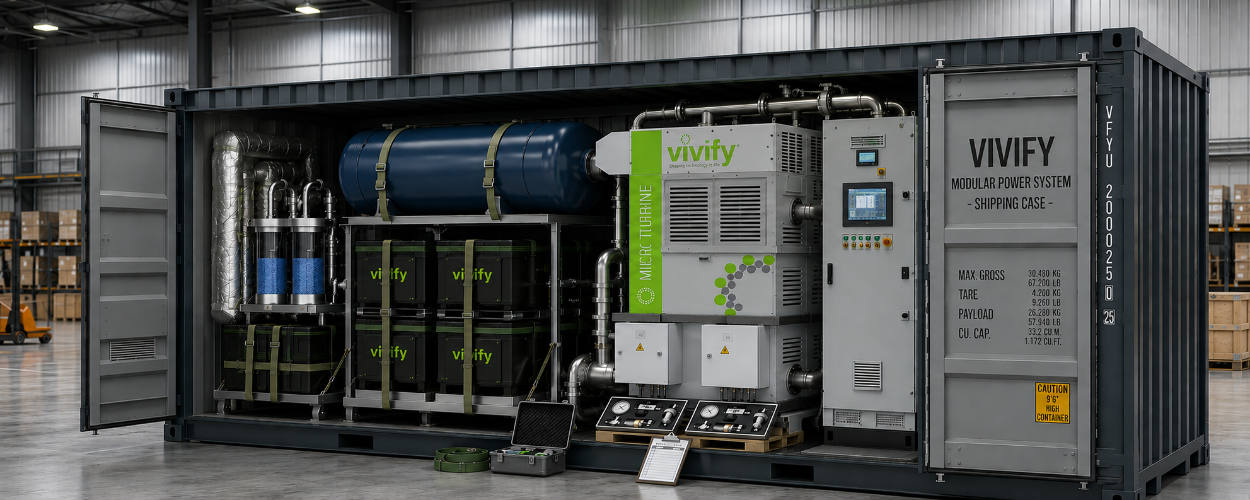
Deployment platform
Flying Pig™ · 1MW per unit
1MW
per Flying Pig™ unit, infinitely scalable by module
Hours
field assembly measured in hours, not weeks
Zero
ongoing fuel resupply required to operate
99%
pollutant-free output at the point of generation
01 — The Reality
Every year, the same infrastructure gets asked to survive the same storms—and every year, some of it doesn’t. The statistics below are not a forecast. They are the operating environment.
8–14 named storms
Projected for the 2026 Atlantic season, with 3–6 forecast to become hurricanes. NOAA’s own guidance to residents: “it only takes one.”
90 declarations
FEMA Major Disaster declarations in 2024 alone—nearly double the 30-year average of 55 per year. That is one Major Disaster declaration roughly every four days.
27 events / $182.7B
Separate weather and climate disasters struck the U.S. in 2024, totaling $182.7 billion in damage—the fourth-costliest year on record.
403 disasters
Weather and climate disasters recorded in the U.S. since 1980. Tropical cyclones account for over $1.5 trillion of the total damage and 7,211 deaths.
$450B cumulative
Disaster costs Florida has absorbed since 1980—the highest total of any state, driven overwhelmingly by hurricanes.
7.2 days average
Statewide outage duration in Florida after Hurricane Irma. Monroe County’s outage ran 20 days. Nearly 60,000 utility workers were mobilized to restore service.
02 — Global Exposure
Hurricane season has a start date. Seismic risk does not. Grid failure from ground shaking is a year-round, worldwide operating condition, and it is exactly the kind of no-notice event that behind-the-meter, containerized power is built to answer.
Long-term seismic averages, tracked by the U.S. Geological Survey since roughly 1900, show that major earthquakes are a recurring event on the global calendar. Every one of these events can sever transmission lines, damage substations, and rupture the fuel-delivery infrastructure that conventional backup power depends on, at the same moment demand for power spikes hardest.
~15 per year
Magnitude 7.0+ earthquakes occur worldwide every year on average, based on USGS long-term records dating to 1900.
120+ per year
Magnitude 6.0+ earthquakes strike globally each year—more than one every week, based on a compilation of USGS seismic data spanning the past 26+ years.
~55 per day
Earthquakes located globally each year by the National Earthquake Information Center—roughly 20,000 annually.
1 per year
An earthquake of magnitude 8.0 or higher is expected in any given year, based on USGS historical frequency.
03 — The Fuel Problem
Diesel generators are the default answer to grid failure today. They are also a countdown clock—dependent on a fuel-delivery network that the same disaster is actively disrupting.
96 hours
The minimum duration hospitals must be able to sustain emergency power operations under CMS’s federal Emergency Preparedness Rule (42 CFR § 482.15), which NFPA 110’s “Class 96” generator classification is built to satisfy.
29%
Share of Florida gas stations that were out of fuel as of October 14, 2024, in the aftermath of Hurricane Milton—with the Tampa/St. Petersburg area peaking at nearly 73% without fuel at the height of the shortage.
73%
Of the nation’s nursing homes are estimated to be running on inadequate or unreliable emergency power systems, per a national federal audit—including generators that do not supply sufficient power to essential areas and systems as old as 40+ years.
9% per day
Fastest observed daily restoration rate for Florida utility customers after Hurricane Irma—meaning even a rapid recovery still takes the better part of a week.
04 — Government & Defense
For forward-deployed forces, the fuel supply chain isn’t an inconvenience—it’s exposure. The Army’s own casualty data made that case two decades ago, and the Army’s own investment is still proving it today.
1 in 24
Fuel resupply convoys resulted in a U.S. casualty in Afghanistan, the formative data point that reshaped Army energy doctrine and still anchors DoD’s fuel-logistics risk planning today.
2035
The year by which the U.S. Army is required to install a microgrid at every one of its installations under the Army’s Climate Strategy—a direct institutional response to fuel-convoy and grid-dependency risk.
28
Operational Army microgrids currently in place toward that 2035 goal, with 9 more under construction and 18 in design.
2024
The year the Department of Defense’s Tactical Microgrid Standard (MIL-STD-3071) was last formally updated, establishing DoD-wide interoperability requirements for on-site tactical power generation and now under further active revision.
“The Flying Pig™ is not a concept, not a promise, and not another piece of energy-sector theater. This is deployable power, built in America, designed to make the old model irrelevant.”
On-site hydrogen generation, with water as the primary fuel input, removes the convoy from the equation. No fuel truck, no route to secure, no resupply schedule to defend—hydrogen energy is produced where it’s consumed. It’s the same direction the Army’s own microgrid mandate is already moving, just without the wait until 2035.
05 — Humanitarian Stakes
Loss of power is rarely the end of a disaster’s story. It’s the reason the next chapter includes displacement, and it’s why speed of restoration is a humanitarian metric, not just an engineering one.
45.8 million
New internal displacements caused by disasters worldwide in 2024—a record, and nearly double the annual average of the prior decade.
22.4 million per year
Average annual disaster-driven internal displacements recorded worldwide since IDMC began tracking the data in 2008—359 million movements total.
11 million
Americans internally displaced by hurricanes, floods, and wildfires in 2024 alone—a national record for the United States.
54%
Of all 2024 global disaster displacements were caused by cyclones specifically—the single largest driver of forced movement that year.
06 — The Platform
They said it couldn’t be done in a box. Flying Pig™ is HOG™’s most formidable offspring, all the power of VIVIFY’s flagship hydrogen platform, distilled into a single deployable container ready to generate 1MW the moment it arrives on site.
Deployment-ready
Containerized behind-the-meter hydrogen power
Inside the container
Micro hydro turbines, a micro steam turbine stage, the Pulsar™ array tying directly into VIVIFY’s hydrogen architecture, water storage and filtration, primary transformers, and quick-connect coupling—all inside self-contained housing engineered for remote locations and zero tolerance for diesel dependence.
Built to go farther
Hydrogen is stable, non-volatile, and deployable today—the most abundant element in the universe, produced on-site rather than trucked in. Scale by adding modules. The grid can’t follow you where Flying Pig™ will go.
07 — Where This Fits
From disaster-stricken regions to forward operating bases, Flying Pig™ deploys wherever conventional power delivery fails, is delayed, or was never built to reach.
Emergency power for damaged or unavailable grid regions—deployable in hours, not weeks.
Remote field operations, military sites, mobile command centers, and strategic deployments.
Long-duration backup for hospitals, emergency operations centers, and public infrastructure.
Infrastructure restoration support in the wake of large-scale disaster or displacement events.
Power for remote communities and temporary operating bases beyond the reach of the grid.
Emergency Deployment
Talk to VIVIFY about a Flying Pig™ deployment for disaster response, defense, or critical infrastructure resiliency.
This page is provided for informational purposes and is not an offer, contract, or commitment. Third-party statistics are drawn from publicly available government, NGO, and research sources current as of publication and are presented for context; figures are illustrative and specific outcomes will vary. References to third-party organizations do not imply endorsement of, partnership with, or commitment by any such party.
© 2026 VIVIFY Technology. HOG™, CAT™, Flying Pig™, and Pulsar™ are trademarks of VIVIFY Technology.
