Back to Applications

Application 03 — Connected Communities

Hydrogen Power.On Demand.Without Compromise.

Every new community starts with the same question: Where does the power come from? Growth doesn't come with more land; it comes with the same land, asked to do more. Housing. Schools. Mobility infrastructure. The compute and connectivity layer running underneath all of it. Industrial and commercial anchors. Every one of them has to fit inside a footprint that isn't getting any bigger.

VIVIFY changes what fits inside that footprint. Multiple HOG™ units, deployed behind the meter, give a growing, connected community its own power base — for housing developments, school and civic campuses, mobility nodes, digital infrastructure, and industrial anchors alike — scaling from a single facility to a full district without waiting on a utility to find capacity it doesn't have.

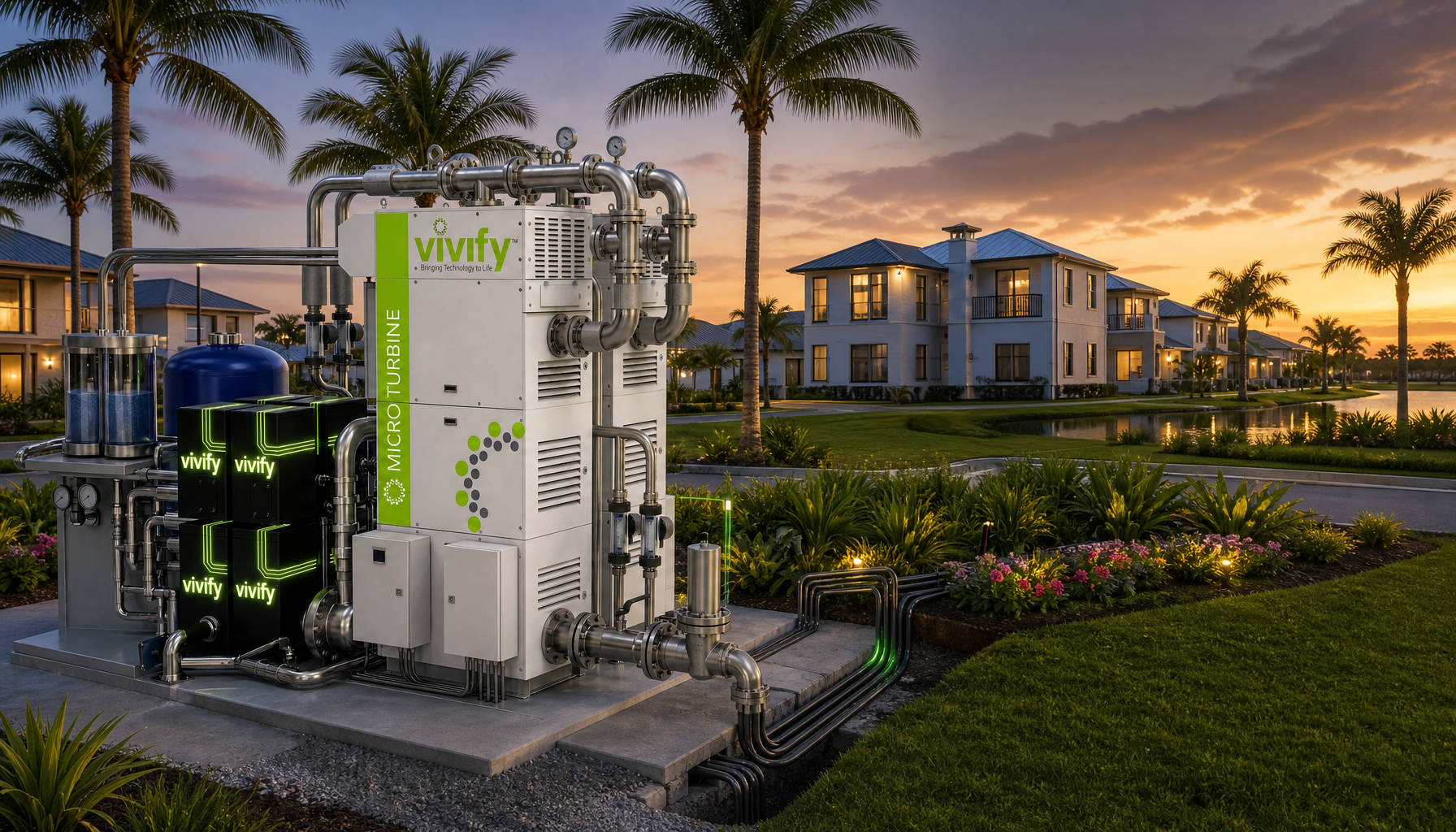
VIVIFY hydrogen power in a residential community
Site to district — power that grows with a community

Site to District

HOG™ scalability from a single facility to a full community footprint

99%

Pollutant-free output at the point of generation

Water

Primary fuel input, produced on-site rather than delivered

No New Land

Behind-the-meter deployment adds power without adding land

01 — The Reality

Growing Communities, Same Footprint

Every community that grows — by population, by housing, by the schools and civic buildings that come with both — is doing it on a fixed amount of land. The pressure that creates doesn't show up as a shortage of ground. It shows up as a shortage of power.

4.03 million

the U.S. housing supply gap in 2025, up from 3.8 million in 2024, according to Realtor.com's 2026 Housing Supply Gap Report — a gap that has to be built somewhere, on land that in most places already has a use.

Source: Realtor.com, 2026 Housing Supply Gap Report, March 2026

64%

share of single-family builders who rated the supply of developed lots as "low" (38%) or "very low" (26%) in the May 2025 NAHB/Wells Fargo Housing Market Index survey — down slightly from 67% in 2023 and 2024, but still higher than any year between 1997 and 2016.

Source: NAHB, "Lots Still in Relatively Short Supply," Eye on Housing, September 2025

02 — When the Grid Decides What Gets Built

When the Grid Decides What Gets Built

For a growing community, the utility interconnection process can be as decisive as zoning. A project can be fully permitted, fully built, and still sit empty because the power connection hasn't caught up.

Behind-the-meter, on-site hydrogen power removes that dependency. A community's power source is no longer a separate approval sitting on someone else's timeline.

182 days

the average energization timeline California's Public Utilities Commission requires of the state's large utilities for connections that do require infrastructure work, with legal maximums running as high as 357 days depending on project type. Even full legal compliance can mean a finished building sits unpowered for six months to a year.

Source: California Public Utilities Commission, Decision D.24-09-020, implementing the Powering Up Californians Act, September 2024

134 projects

construction-ready housing and infrastructure developments stuck waiting more than 8 weeks for grid connection from a single utility, PG&E, as of February 2023 — the backlog that first pushed California lawmakers to act. Of those, 95 had waited more than 12 weeks, and some affordable housing developments waited over 18 months.

Source: California State Senate, Sen. Scott Wiener, legislative announcement, March 2023

03 — Beyond Housing

Mobility and Digital Infrastructure Need the Same Footprint

A connected community isn't just homes. It's the EV chargers and mobility nodes built into new developments, and the compute and connectivity layer running underneath schools, civic buildings, and commercial anchors alike — all of it competing for space and power on the same fixed land.

17%

growth in global electricity demand from data centers in 2025 alone, the infrastructure increasingly powering the cloud-hosted software, learning platforms, and building-management systems that schools, civic buildings, and community developments now depend on.

Source: International Energy Agency, “Key Questions on Energy and AI,” 2026

04 — Same Land, Shared Infrastructure

Schools and Civic Buildings

Growth doesn't only mean new houses. It means the schools, civic buildings, and shared community infrastructure that a growing population needs, built on the same constrained land, and just as dependent on power that has to be there before anything else can open.

$85 billion

the nation's annual public school facilities funding gap in the 2025 State of Our Schools report, up sharply from $46 billion when the series began in 2016, even as districts have nearly doubled their own annual spending on facilities, from $95 billion to more than $150 billion, over the same period.

Source: 21st Century School Fund, “2025 State of Our Schools”

80% / 17% / 3%

the split of school capital construction and equipment funding in the U.S. between local, state, and federal sources (FY2014–2023), leaving most communities to fund their own facilities directly.

Source: 21st Century School Fund, “2025 State of Our Schools”

99,970

the number of public schools operating in the U.S. in the 2023–2024 school year, spread across an average of 8 buildings each — nearly 800,000 buildings nationwide.

Source: 21st Century School Fund, “2025 State of Our Schools”

$56 billion / $29.4 billion

the split of the annual gap between capital investment (short by $56 billion a year) and maintenance and operations (short by $29.4 billion a year).

Source: 21st Century School Fund, “2025 State of Our Schools”

05 — The Platform

HOG™ — Power That Scales With a Community

The HOG™ is not a prototype. It is a fully realized, self-supporting hydrogen energy system powered by water as its primary fuel input, producing near-zero emissions, and scaling on demand. A single HOG™ unit serves a single facility. Multiple units, deployed together, serve a district, without asking for more land or a new utility connection for each addition.

VIVIFY HOG hydrogen power system
Site to district — power that grows with a community
Fuel Source
Water as primary fuel input
Emissions Profile
99% pollutant-free output
Architecture
Self-supporting, behind-the-meter
Scalability
Site to district — modular by adding units
Key Integration
Pulsar™ on-demand hydrogen revitalization
Land Footprint
No new land required beyond the site itself
Deployment Path
No utility interconnection queue to enter

For a growing community, that means a housing development, a school, and a civic facility can each be powered without competing for the same finite grid capacity, and without the community waiting on a utility's timeline to open its doors.

06 — Where This Fits

Power for the Places Communities Are Already Building

From new residential developments to the mobility, digital, and civic infrastructure that grows alongside them, HOG™ deploys on the same land a community already has, not land it's waiting to acquire.

New Residential Communities

Behind-the-meter power for new housing developments that would otherwise wait on a utility connection to open.

School & Civic Campuses

Dedicated power for schools, stadiums, and civic buildings serving a growing population, scalable as demand grows.

Mobility Ecosystems

On-site power for EV charging infrastructure, transit hubs, and other connected mobility nodes built into a community.

Digital & Compute Infrastructure

Dedicated, high-uptime power for the connectivity and compute layer running underneath a connected community, from smart-city sensors to edge processing nodes.

Industrial & Mixed-Use Anchors

Power for the industrial, commercial, and mixed-use development that gives a growing community its tax base and jobs.

Municipal & Utility Partnerships

Coordinated deployments alongside municipalities and utilities looking to add capacity without new transmission build-out.

Connected Communities

The Engineering Is Done. The Deployment Has Begun.

Talk to VIVIFY about behind-the-meter hydrogen power for a growing residential community, school campus, or civic development.

Contact

Ashley Stevenson — Chief Marketing Officer

ashley@vivify-technology.com888.277.8370

Locations

  • Delray Beach — Corporate Office
  • Delray Beach — Lab
  • Jupiter — Manufacturing (begins January 2027)

This page is provided for informational purposes and is not an offer, contract, or commitment. Third-party statistics are drawn from publicly available government, research, and news sources current as of publication and are presented for context; figures are illustrative and specific outcomes will vary. References to third-party organizations do not imply endorsement of, partnership with, or commitment by any such party.

© 2026 VIVIFY Technology. HOG™, CAT™, Flying Pig™, and Pulsar™ are trademarks of VIVIFY Technology.