
219
coal-fired power plants are operating in the U.S. today, running 462 individual generating units.
Source: U.S. Energy Information Administration, “How many power plants are in the United States?”
Application 04 — Clean Emissions
The industrial sector has been told for decades that clean operation means compromised performance. VIVIFY's Clean Air Technology™ (CAT™) is the answer to that false choice. A retrofit-ready five-stage platform designed to remove virtually all pollutants from exhaust streams, built for real-world integration across multiple fuel types and industrial environments, without compromising operational reliability.
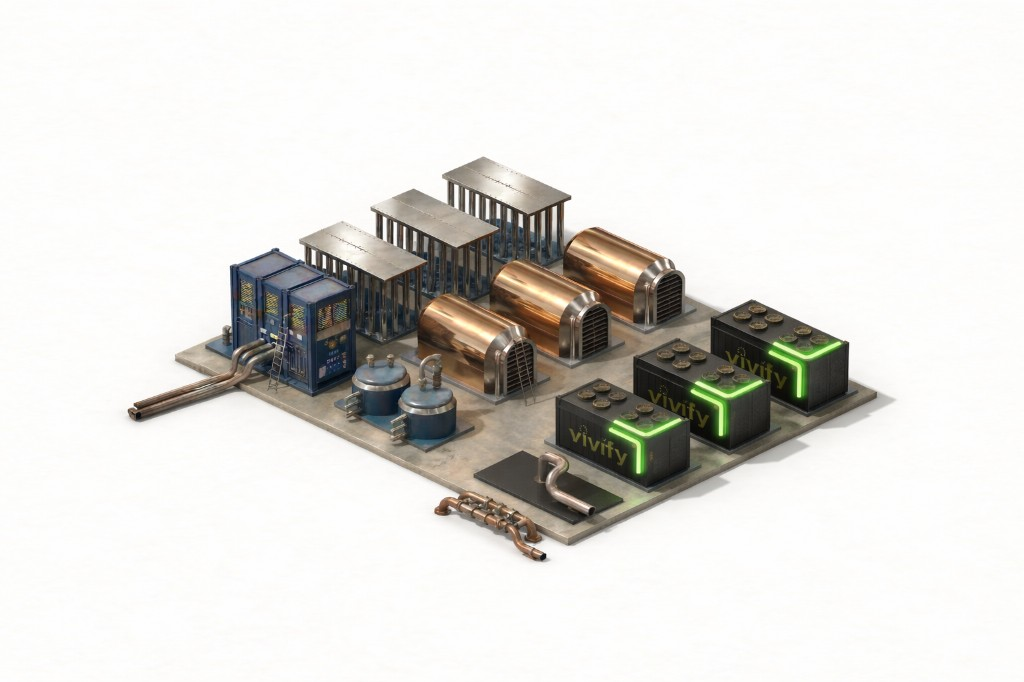
Five-Stage
Filtration, separation, and incineration architecture
Retrofit-Ready
No teardown required
Significantly Reduced
Parasitic load versus unmodified legacy systems
Zero
New land or new construction required for deployment
01 — The Reality
Coal is one of the largest single sources of U.S. electricity, running on a fleet of plants that are staying online longer than expected. That fleet is exactly where retrofit-ready emissions control matters most.
219
coal-fired power plants are operating in the U.S. today, running 462 individual generating units.
Source: U.S. Energy Information Administration, “How many power plants are in the United States?”
~189,000 MW
combined nameplate generating capacity of the current U.S. coal fleet — roughly 189 gigawatts still online.
Source: U.S. Energy Information Administration, “How many power plants are in the United States?”
15% to 17%
coal's share of U.S. electricity generation, per EIA's short-term forecast: 17% in 2025, easing to roughly 15% in 2026, and still one of the largest single sources on the grid.
Source: U.S. Energy Information Administration, Short-Term Energy Outlook
87.6%
share of all U.S. coal consumption that went toward generating electricity in 2024, the primary use case for coal in the country.
Source: U.S. Energy Information Administration, Annual Coal Report
02 — Aging Fleet, Extended Operations
The coal fleet isn't shrinking as fast as it was expected to. Plants that were scheduled to close are staying open, which means the emissions control question isn't going away; it's getting more urgent.
2.6 GW
total coal-fired generating capacity retired in 2025 across just four plants, the smallest annual retirement total in 15 years.
Source: U.S. EIA, “U.S. coal-fired generating capacity retired in 2025 was the least in 15 years”
172 GW to 145 GW
the coal fleet's projected capacity decline from May 2025 to the end of 2028, a slower drawdown than earlier projections assumed.
Source: U.S. EIA, “Most of the planned coal capacity retirements are in the Midwest or Mid-Atlantic regions”
6.4 GW
coal capacity still scheduled for retirement in 2026, about 4% of the operating fleet, while the rest stays online.
Source: U.S. EIA, “Retirement delays of U.S. electric generating capacity may continue in 2026”
7.1 GW
coal-fired capacity that didn't retire as originally planned: 4.8 GW had its retirement delayed to a future year, 1.2 GW had its 2027 retirement canceled outright, and another 1.1 GW across two plants also had retirement plans canceled, as plants that were supposed to be offline are staying online instead.
Source: U.S. EIA, “U.S. coal-fired generating capacity retired in 2025 was the least in 15 years”
03 — What's Still in the Exhaust Stream
EPA's own data makes the case plainly: pollution controls work. But the roughly 219 coal-fired power plants still operating today are still emitting SO2, NOx, and mercury, and the reductions of the last three decades only hold if operators keep investing in the retrofit equipment that produced them.
18%
the increase in sulfur dioxide pollution from U.S. coal-fired power plants in 2025, the second-largest annual increase in the 30 years EPA has tracked the data, only behind 2021's post-pandemic rebound.
Source: NRDC analysis of EPA emissions data, "Coal Pollution Spiked After Trump Administration's 'Free Pass to Pollute,'" February 2026
667
estimated premature deaths in 2025 tied to sulfur dioxide pollution from just six exempted coal plants in Texas alone.
Source: NRDC analysis of EPA emissions data, "Coal Pollution Spiked After Trump Administration's 'Free Pass to Pollute,'" February 2026
$8.8 billion
the public health cost of sulfur dioxide pollution from those same six Texas plants in a single year; together, they emitted more SO2 than any other state's entire power fleet.
Source: NRDC analysis of EPA emissions data, "Coal Pollution Spiked After Trump Administration's 'Free Pass to Pollute,'" February 2026
90%+
the nationwide reduction in SO2 emissions from power plants achieved over the past 30 years through pollution controls — the exact trend 2025 just interrupted.
Source: NRDC analysis of EPA emissions data, "Coal Pollution Spiked After Trump Administration's 'Free Pass to Pollute,'" February 2026; U.S. EPA, Progress Report — Emissions Reductions
04 — The Platform
Legacy industrial infrastructure won't disappear overnight. CAT™ is the answer to that reality. It’s a five-stage emissions control system that removes virtually every pollutant from exhaust streams without forcing operators to shut down and start over.
Built as a retrofit-friendly platform, CAT™ reduces parasitic load, improves plant efficiency, and delivers a cost-effective path to near-zero output across both legacy and modern industrial environments, without touching operational reliability.
05 — Where This Fits
From power generation to heavy manufacturing, CAT™ deploys on the infrastructure operators already have — not infrastructure they have to build new.
Upgrade existing generation and thermal systems for cleaner operation.
Reduce emissions in manufacturing, processing, and heavy industry environments.
Deliver compliance-ready upgrades without sacrificing uptime.
Retrofit aging coal and oil-fired generation without a teardown or rebuild.
Support facilities running more than one fuel type through a single platform.
Clean Emissions
Talk to VIVIFY about retrofitting existing generation or industrial exhaust systems with CAT™.
This page is provided for informational purposes and is not an offer, contract, or commitment. Third-party statistics are drawn from publicly available government sources current as of publication and are presented for context; figures are illustrative and specific outcomes will vary.
© 2026 VIVIFY Technology. HOG™, CAT™, Flying Pig™, and Pulsar™ are trademarks of VIVIFY Technology.
